Are we Getting Da'wah all Wrong?
We’re trying to win the argument, not invite people to Islam

Online Da’wah is becoming a blood sport.
The culture of having to ‘dunk’ on the opposition and beat them into intellectual oblivion has taken a hold of us.
Da’wah (inviting to Islam) has become a contest for egos to shine.
Online debates have become entertainment.
We tune in to see if our representative can beat the opposing sides representative.
We win, because we have the truth on our side, it feels good, but how many people in the process have we pushed away from Islam?
How many people have doubled down on their anti-Islamic views because they’ve been embarrassed and belittled in front of the whole world?
I read a story the other day from during the time of the Prophet ﷺ and can’t stop thinking about how wrong we’re getting it.
It’s the incredible story of Thumama ibn Uthal.
The Most Dangerous Man in Arabia
In the sixth year after hijrah, the Muslims were establishing themselves as an increasingly powerful force in Arabia and the Prophet ﷺ began sending letters to rulers of the region to invite them to Islam.
Some rulers responded with diplomacy. Some ignored him. And then there was Thumama.
Thumama ibn Uthal was chieftain of the Banu Hanifah and one of the rulers of al-Yamamah, making him among the most powerful men in Arabia.
He ruled a region that essentially wrapped around Mecca and Medina. He controlled the trade routes north to Sham, south to Yemen, east to Iraq. If you wanted grain, dates, or anything that moved through the desert, you had to go through his territory. He was not just a tribal chief. He was like a king in every sense.
When the Prophet’s letter reached him, he did not send back a polite refusal. He murdered the entire convoy.
Not just the messenger, the entire mission.
This was a declaration of war from a man who could strangle both Medina & Mecca economically without lifting a sword.
Up until this point the strategy with Thumama was simple: do not poke him.
You wanted to leave him alone so he left you alone.
But Allah had other plans.
Months later, a Muslim patrol was hunting mercenaries in the desert.
They came across a group of travellers that didn’t look quite right.
It was a caravan that looked important, but it never had the protection that would normally accompany this type of convoy.
So they captured the group and took them back to Medina.
Among the men was a tall man in the robes of a king.
The Prophet ﷺ looked at the companions and said: “Do you know who you have brought?”
It was Thumama.
Can you imagine it? A man who has the blood of your companions on his hands, a man who has just declared war on you, one of the most powerful men in the region with the ability to fund an entire army against you or economically starve you has just been brought to your front door, accidentally. Subhan’Allah.
The Prophet ﷺ had every right to kill him.
It would send a chilling message to the entire region.
He had the right to demand whatever blood money or ransom that he saw fit.
His response could strike fear into the heart of every opposition force to Islam.
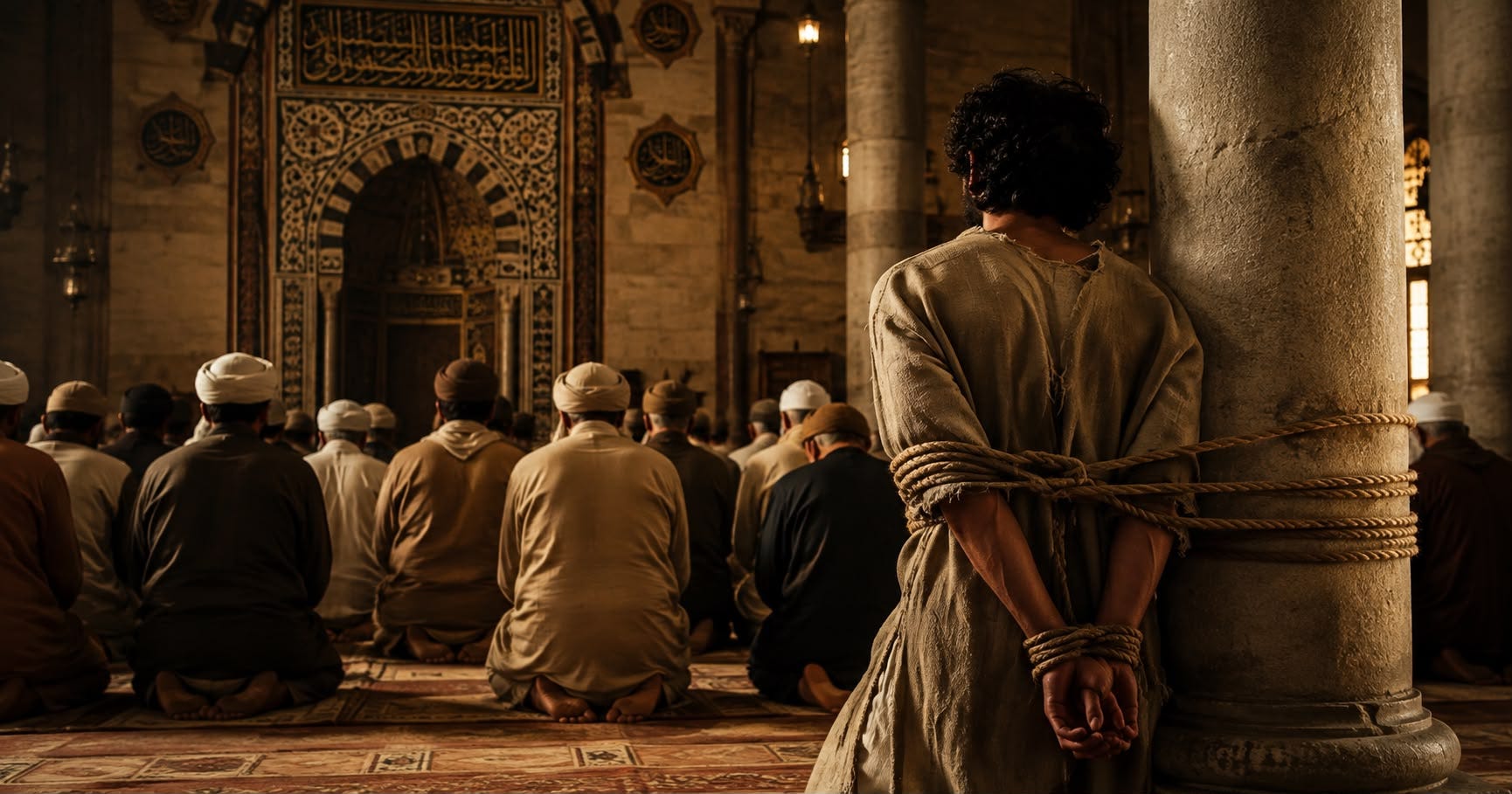
The Prophet ﷺ ordered he be tied to a pillar in the mosque and then did something strange.
He ﷺ ordered that the best food and drink be brought to him.
Muslims obliged by giving him the best they had to offer: milk, dates and meat. Thumama was eating better than most of the Muslims. Even food that was being made and prepared for the Prophet ﷺ was being given to him.
Imagine sharing your meals with a prisoner of war who wants you dead.
The Prophet ﷺ approached him and said: “What do you have, O Thumama?”
He responded: “If you kill me, you will kill a person who has heavy blood (i.e my death will be avenged). If you do me a favour, you will do a favour to a grateful person. If you want wealth, ask and you will get whatever you will demand.”
The Prophet ﷺ smiled and walked away.
The next day The Prophet ﷺ approached him and asked: “What do you have, O Thumama?”
He responded again by saying: “If you kill me, you will kill a person who has heavy blood. If you do me a favour, you will do a favour to a grateful person. If you want wealth, ask and you will get whatever you will demand.”
The Prophet ﷺ once again smiled and walked away.
The third day came and once again he was asked the same question, his response this time was: “What I have already told you”.
The Messenger of Allah (ﷺ) said: “Set Thumama free.”
Thumama stood up and walked straight out of the mosque.
Everyone was bewildered.
No ransom. No revenge. No prisoner exchange. No conditions.
He just got to leave.
About ten minutes later Thumama walked back into the mosque and declared:
I bear testimony that there is no god but Allah and I testify that Muhammad is His messenger.
He then said:
O Muhammad ﷺ, by Allah, there was no face on the earth more hateful to me than your face, but now your face has become to me the dearest of all faces.
By Allah, there was no religion more hateful to me than your religion, but now your religion has become the dearest of all religions to me.
By Allah, there was no city more hateful to me than your city, but now your city has become the dearest of all cities to me.
Do you see what happened?
Where has he just spent the last three days?
Inside a mosque observing Muslims.
There wasn’t a show put on for him.
Just three days of unfiltered access watching Muslims pray, recite Quran and hearing the Prophet ﷺ speak to the congregation.
Whilst being shown genuine kindness and hospitality.
That’s all it took.
That’s all it took for a man to give up his kingship.
Incredible.
The first Muslim to perform Umrah
Remarkably, the story doesn’t even stop here.
He was in the convoy that was captured as he was on his way to Mecca to perform Umrah (pagans performed this in the days before Islam).
Now he asked the Prophet ﷺ: “what should I do?”
The Prophet ﷺ taught him how to perform Umrah as a Muslim and sent him on his way.
Thumama became the first person in history to enter Mecca to perform Umrah as a Muslim.
As he was reciting the Muslim talbiyah affirming the absolute oneness and sovereignty of Allah. The idol worshippers of Mecca were incensed. They drew their swords. Who was this man calling upon one God in their city, the city of idols? They moved to attack him but realised who he was.
“Have you left the religion of your forefathers?” they asked.
Thumama replied: “No. I have embraced Islam with Muhammad ﷺ, the Messenger of Allah.”
Then he made them a promise:
“By Allah, not a single grain of wheat will reach you from Yamama until the Prophet ﷺ gives me permission.”
The people of Mecca had to beg the Prophet ﷺ to tell Thumama to open the trade routes back up.
He ﷺ commanded Thumama to lift the boycott. And Thumama, now a loyal Muslim, obeyed without question.
This resulted in a colossal power shift in the region which would ultimately lead to the conquest of Mecca a few years later.
The problem with winning
Here is what did not happen.
The Prophet ﷺ did not debate Thumama. There was no theological sparring match. No point-by-point refutation of idol worship. No clever takedown of pagan belief. No “destroying” him with facts and logic.
He ﷺ did not lecture him. He ﷺ did not sit him down and run through the proofs of Islam. He ﷺ did not demand an explanation for why Thumama had killed his companions.
His conversion happened because he saw Islam. Not an argument for Islam. Islam embodied, in the character of the Prophet ﷺ and the community around him.
We have turned calling people to Islam into a contest.
This is the impulse response. When someone attacks and smears your faith. When they lie, and propagandise your beliefs.
You want to beat them. Embarrass them.
But we have to remind ourselves they are not our teachers, the Prophet ﷺ and His ﷺ companions are.
They are the example of what we have to strive to embody.
There is no point meeting them at their level because as soon as we do we’ve lost.
The Prophet ﷺ could have killed Thumama and been justified.
He could have ransomed him and funded the Muslim army.
He could have humiliated him and sent a message to every ruler in Arabia.
He instead treated his enemy with dignity. He fed him the best food & let him go free.
And what happened?
A conversion that was so transformative that the Quraysh, who had spent years persecuting the believers, were now begging the Prophet ﷺ to stop his newest companion from starving them.
What will you show them?
The next time you have the opportunity to represent Islam to someone, ask yourself: will my actions and words bring people to Islam or push them away?
Winning feels good for about five minutes but it only serves your ego, nothing else.
You might be someone’s only example of Islam they ever experience in their entire life.
But imagine they saw something they didn’t expect? Dignity instead of pettiness. Patience instead of rage. Generosity instead of greed.
That is what happened to Thumama.
Three days of watching Muslims be Muslims, and the most hated face on earth became the most beloved.
The Prophet ﷺ did not win an argument with Thumama ibn Uthal. He won a heart. And through that heart, an entire kingdom.
And whose words are better than someone who calls ˹others˺ to Allah, does good, and says, “I am truly one of those who submit.”? Good and evil cannot be equal. Repel evil with what is better and your enemy will become as close as an old and valued friend” Quran 41:33-34
Discussion about this post