How to start enjoying life again
And why nothing feels remotely satisfying anymore

You might have noticed something.
Nothing feels remotely satisfying anymore.
Things that we used to take pleasure from don’t even move the needle.
Nature has become boring.
Conversations have become dull.
A good meal has become convenience.
Even watching a movie has become a chore.
Can you remember that feeling on a Sunday evening before going back to school the next morning? We now have that feeling all week.
It’s strange, though. At no point in human history have we had access to more pleasurable things than we do right now. We can get an instant hit of pleasure at any moment we choose. In theory, we should be the happiest civilisation ever to exist.
But what if this constant access to cheap artificial stimulation is the very thing stripping our lives of the moments we used to enjoy?
Honestly, it’s ridiculous that the school system never taught us what we are about to get into.
Thirteen years of compulsory education, and I don’t remember a single lesson on how the neurological reward system influences our behaviour, relationships, addictions and even our mental health.
I’m glad I know how to factorise a quadratic equation, though.
You never know when you might need to find the roots of 3x² + 7x − 6 = 0.
I digress.
The good news is you don’t need to be a neuroscientist to understand this. Even a basic understanding will allow you to radically alter your life. But we first need to understand how dopamine works.
Dopamine
Dopamine is probably the most misunderstood chemical in your body.
It is not pleasure.
Everyone thinks it is, but pleasure is what you feel when the thing is happening.
Dopamine is the anticipation of getting the thing, not the satisfaction of having it.
It’s the wanting, not the having.
Your brain will always remember what made it feel good.
So it constantly looks to return to those habits and behaviours that gave it the most pleasure. Dopamine creates a buzz from the anticipation of getting these pleasurable things, and tells you “go get it again, that felt so good, didn’t it?”
So dopamine’s job is to decide what you’re going to pay attention to and how you’re going to get it.
If dopamine says “this really matters, you need to get it, right now”, consider what the brain used this sentence for in the past.
For almost all of human history, this sentence was needed for making fire, hunting for food, searching for a mate or finding a water source.
Dopamine is a survival mechanism.
Without dopamine, nobody would be motivated to get out of the tent. The system is not flawed. It’s flawless.
It’s doing exactly what it was designed to do.
Creating motivation for the things that it feels are essential for your survival.
Unfortunately, the modern world has blurred the lines and tricked your dopamine system into giving you a survival-level response for something that required no effort, had no cost, and has no stopping point.
We now have access to a never-ending stream of pleasure, and every hit pushes our dopamine system higher and higher, never letting it settle.
And unfortunately, what goes up must come down.
The Dopamine Seesaw
Any high amount of dopamine that comes to you without effort will eventually destroy you, or bring you very close to destruction.
- Andrew Huberman
Your brain is constantly trying to keep things balanced.
This is called homeostasis: a state of balance among all the body systems for the body to function correctly.
Your brain hates being pushed too far in one direction. It’s unnatural.
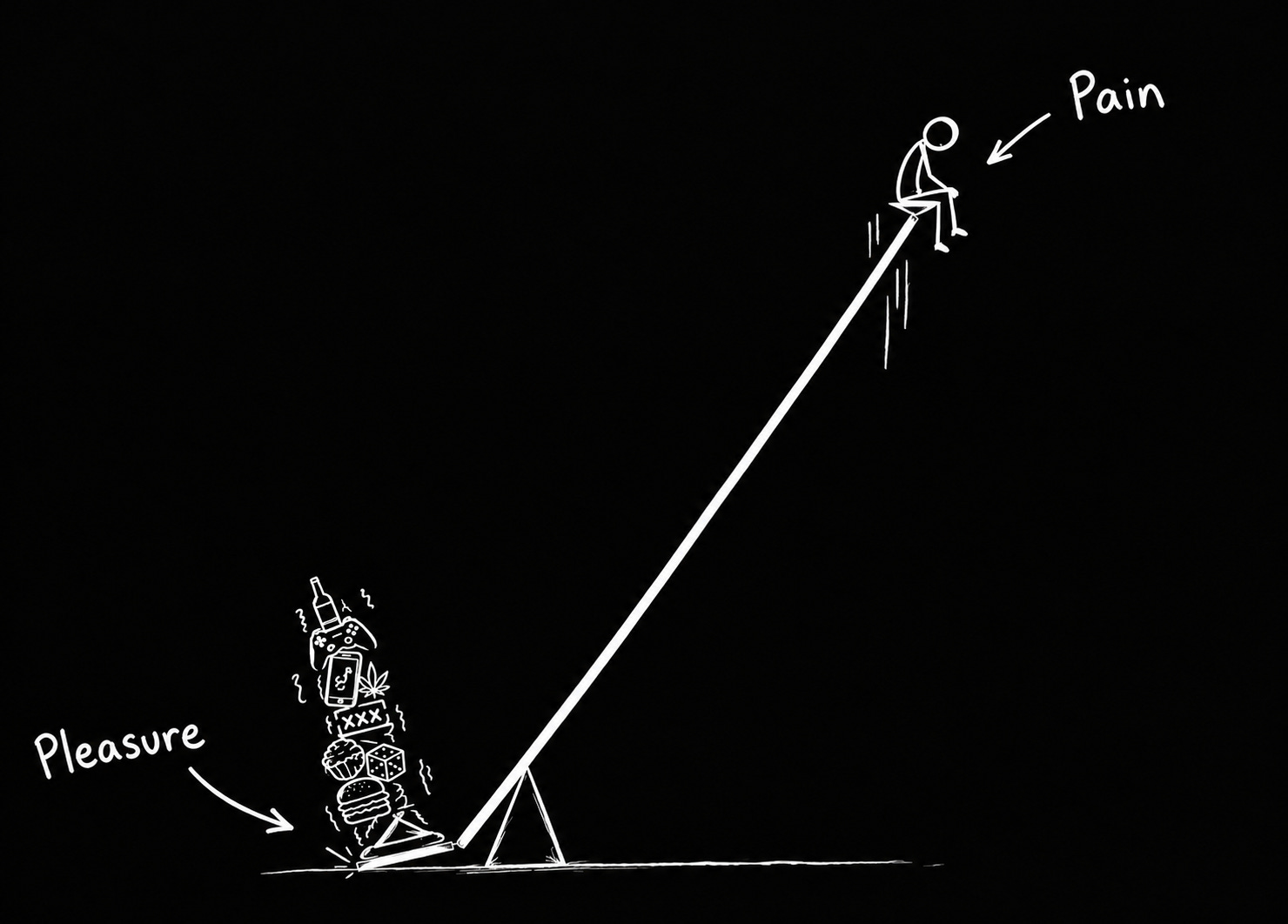
Now I want you to imagine a seesaw with one side pleasure and one side pain. When you experience something pleasurable, the seesaw tips toward pleasure. It cannot stay there though, so your brain tips the seesaw back in the pain direction.
It tips it back in the pain direction, in direct proportion to the amount of pleasure experienced.
This means when you do something super pleasurable, you push way past the baseline you started at and slide into the side of pain.
Why? Well, if it just brought you back to baseline there would be no second thoughts about spending your life engaged in the most insanely degenerate pleasurable activities.
We wouldn’t get far as a species if that was the case, although some people are trying.
The hangover acts as a warning.
The comedown is an alarm.
Your brain telling you “please stop, this is not good”.
Most people have stopped listening to the internal voice of reason and accepted these feelings of utter despair as the price for ‘having fun’.
Here’s the thing that should be mandatory for all children (and adults) to learn:
With repeated exposure to highly stimulating rewards, your brain adapts. This causes the pleasure response to become weaker, while the opposing pain response becomes stronger.
In other words, the pleasure begins to cause the pain.
Remember the role of dopamine is the anticipation of the pleasure you are about to receive. So what happens when your brain expects the reward, but it never comes?
Well it’s obvious, it tells you it needs more.
But your brain is not chasing more. It’s chasing the feeling of the first time. The initial high. And when it doesn’t deliver, you drop lower than before on the pain side.
Take the use of cocaine as an example. When first taken, it pushes your dopamine and pleasure to a level like nothing it’s experienced before.
Your survival mechanism activates to remember this event, logging the enormous pleasure it brought as something to pursue again.
Remember, for thousands of years, from a hunter-gatherer perspective, something with this amount of pleasure had to be a good thing.
But here’s the massive issue. Nothing in ordinary life comes close to the intensity and speed of that reward. It was so easy; zero effort was required, so you begin to crave it, until it becomes the only thing you can think about.
Remember: “Go get it again, that felt so good, didn’t it?” This is where the addiction begins.
The progressive narrowing of the things that give you pleasure.
Spending time with your children can’t compare to that high.
Spending time with friends can’t compare to that high.
Eating a good meal can’t compare to that high.
Working out can’t compare to that high.
You become hooked and trapped on a dopamine death loop because nothing will ever fill the void for the thing you’re craving. You don’t need to be addicted to cocaine to experience this. Take the cocaine away.
Replace it with alcohol.
Replace it with gambling.
Replace it with social media.
Replace it with porn.
Replace it with weed.
Replace it with sugar.
Replace it with online shopping.
The substance or the behaviour might be different, but the mechanism is the same.
Things that give you enormous reward with very little effort will destroy you because you will begin to do anything you can to escape the feeling of not having it.
Now can you imagine the state of the seesaw when you have all of the above habits stacked on top of each other day after day?
Is it any wonder there’s a mental health epidemic?
This is how billions live; this is how we’ve been told to live. This is ‘freedom’.
The paradox is that hedonism, the pursuit of pleasure for its own sake, leads to anhedonia, which is the inability to enjoy pleasure of any kind.
- Anna Lembke, author of Dopamine Nation
Well that was pretty depressing to type.
But all hope is not lost.
The Other Side of the Seesaw
Can you remember how our brain is constantly looking to be in a state of homeostasis?
Well it cannot stand constantly sitting on the pain side any more than it can stand constantly sitting on the side of pleasure.
If you have ever got in an ice bath you’ll have experienced this. You jump in and experience a minute or two of absolute torture but after you feel euphoric.
This is the seesaw working in reverse.
So when you deliberately push it toward pain, the counterweight pushes in the other direction back toward pleasure. But this time the pleasure comes with no side effects.
This really matters.
The pleasure you get from something that comes easy, arrives before the thing happens. It is anticipation. After it spikes, it crashes, and then you feel low, unmotivated, irritable, and anxious.
The pleasure you get from something difficult arrives after. It arrives slowly and naturally. Your brain releases dopamine across the entire effort, not in one burst. This leaves you on a natural high, motivated and actually enjoying life.
So what is the solution to finally start enjoying life again?
Start doing hard things.
This is what we’ve been designed for.
When the modern world taught us to chase pleasure to feel good. The brain has actually been designed to make us feel good after doing hard things.
We have kept the reward and removed the difficulty.
And now we’re confused about why the reward system has stopped working.
But we’re not too far gone. With just a few mindset and lifestyle shifts we can undo the decades of thrilling ourselves into oblivion.
The Prescription
All neuroscientists agree on what wrecks the reward system.
Substance abuse.
Alcohol.
Pornography.
Gambling.
Social media doomscrolling.
Junk food.
Nothing on that list requires effort to consume. Cheap thrills that keep you coming back for more. And look at what modern neuroscience increasingly recommends in response.
Abstinence from the thing that overstimulates you.
Delaying gratification.
Fasting.
Mindfulness.
Exercise.
Embracing boredom.
Acts of service for others.
Every item costs you something in the short term with the repayment coming later.
Do you notice what you’re actually looking at? One list is built around immediate gratification. The other is built around discipline and restraint.
One asks, “What do I want right now?”
The other asks, “What is good for me in the long run?”
And this is what makes me so incredibly grateful that Allah has blessed us with Islam.
Because this is exactly what Islam has been teaching us from the start. Fast when you want to eat. Pray when you want to sleep. Lower your gaze when you want to look. Give when you want to keep. Restrain yourself when you want to indulge. Be patient when you want the immediate reward.
Modern neuroscience is now arriving at the framework we were given over fourteen hundred years ago.
The solution was never hidden. It is being practised by the very people the modern world thinks are missing out.
Modern science is not teaching us how to live.
It is confirming the instructions we were given by the One who knows us better than we know ourselves.
If addiction is the progressive narrowing of the things that give you pleasure, then Islam is the progressive narrowing of the only thing that matters.
Have you seen those who have taken their own desires as their god? Allah left them to stray knowingly, sealed their hearing and hearts, and placed a cover on their sight. Who then can guide them after Allah? Will you not then be mindful?
Al-Jathiyah 45:23
Disclaimer and full transparency: I have absolutely no idea how to find the roots of 3x² + 7x − 6 = 0.
Living in a culture that demands instant gratification makes Islamic practices feel like a sanctuary for the soul. Fasting and choosing purity like holding back from porn or instant hits of dopamine rewires how we experience joy. It teaches our souls that restraint builds strength, not lack. Come Ramadan, that lesson becomes so vivid. You spend the whole day holding back, and then one simple sip of cold water at Iftar feels like pure mercy and immense joy. How blessed we are that our faith continually grounds us, turning basic moments of patience into profound spiritual fulfillment
This is really amazing. I want everyone to tell a story about my social media addiction. I used to keep scrolling for 6 hours or more a day and l lost my focus and attention. Also l was losing my connection to Allah.
But lately l wanted to quit it and return back to my life again so l watched a lot of YouTube videos and read articles on how can l quit my addiction. Those methods really worked and now l am grateful that l have got to learn about this dopamine system and how it rewards us. I got a lot of control over my social media use but eventually l deleted my Instagram and snapchat and even YouTube.
Now my life looks a lot better. I have now better relationship with Allah.I have much time for my hobbies, l can study properly and l have got my attention span back. I can focus on hard things better and l am now heading on to learn new skills.
And this article also really helped me a lot to see it from the perspective os lslam.