You’re Going to be Questioned About Your Screen Time
A 5 step plan to finally get off your phone

Can you imagine standing in front of Allah and having to try to justify six hours per day of screen time?
And you’re asked why you’re not a memoriser of the Quran.
or why you don’t know the basics of your religion.
or why you skipped prayers and other obligations.
You try to muster some half-hearted response about how you “didn’t have the time” or were “too busy”.
Then you’re shown the amount of YEARS you spent on your phone.
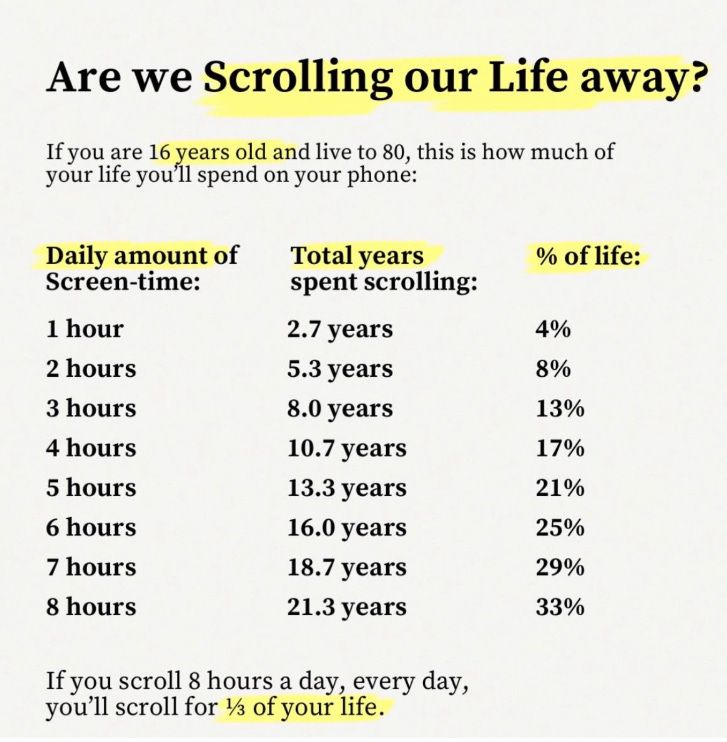
We are running toward this reality.
On average we pick up our phones 150 times per day, but we struggle to pick the Quran up just once.
This isn’t only going to be a problem once we face Allah, it is having terrifying consequences, right now.
Our brains are rotting.
We can’t concentrate.
We’re losing the ability to experience joy.
Our memory is getting worse by the day.
We’ve outsourced all our critical thinking to chatgpt and claude.
The Odds are Stacked Against you
The most important thing to understand is this: You are not going to overcome this using your willpower.
This is not a willpower problem.
The smartest engineers and psychologists in the world have spent a generation making your phone irresistible.
The same mechanism that keeps a gambling addict feeding the slot machine has got you putting your hand in your pocket over one hundred times a day.
The social feed which never ends is the casino.
The anticipation of what we might find with that next refresh is just too much to refuse.
Our dopamine receptors never get the chance to rest, constantly jacked up on artificial junk.
Anything that induces this amount of dopamine, at such a frequency, compounds over time to induce anhedonia (the inability to feel pleasure or joy).
Not to mention the internal chaos caused by feeling ten emotions in just one minute.
We’re quite literally being thrilled to death.
Our brains have been trained to expect new novel-information every five seconds.
This is why you struggle with reading a book, or a long article like this one, or even watching a movie.
You need that hit a lot quicker than ever before.
Our brains are being fried and are dying to breathe.
Ghaflah: Our New State
Ghaflah is a state of spiritual heedlessness in which a person becomes distracted from Allah and forgets what ultimately matters.
The phone is the most efficient ghaflah machine ever built.
Allah says in the Quran:
They have hearts they do not understand with, eyes they do not see with, and ears they do not hear with. They are like cattle. In fact, they are even less guided! Such ˹people˺ are ˹entirely˺ heedless. Quran 7:179
Now obviously, this isn’t talking about mobile phones, but just think about what it is saying.
Allah describes the heedless even further astray than cattle.
This is what these devices are turning us into.
Heads bowed to a six-inch screen.
Grazing on blue light.
We’re becoming the cattle.
But unlike the cattle, we have a choice.
We can continue wasting our lives on these devices or we can take back control.
If you’re ready to fight back, I must warn you: it’s going to be a war.
You’re going up against an opponent who has more resources than entire nations.
An opponent who has spent decades studying your brain, harvesting your data, and watching your every move until they know exactly what keeps you coming back for more.
Imagine a gambling addict trying to kick the habit whilst living in the casino - this is now you.
But this disease has a cure, and it’s reversible.
The antidote
Before giving you an actionable plan we first have to speak about the antidote to ghaflah.
If ghaflah is forgetfulness then the remedy is found in its opposite: remembrance (dhikr)
Remembering our ultimate purpose in life, which is to: worship Allah, to love Him, to obey Him and submit to Him.
Dhikr is one of the greatest means of achieving this.
“And the remembrance of Allah is greater...” (29:45)
“Remember Allah much that you may be successful.” (8:45)
“Truly it is in the remembrance of Allah that hearts find peace” (13:28)
“O you who believe, let not your wealth and your children divert you from the remembrance of Allah” (63:9)
“The parable of the one who remembers his Lord and the one who does not is like the parable of the living and the dead” (Bukhari)
How often are we forgetting Allah due to these devices?
Dhikr is the medicine.
And we desperately need a prescription.
Dhikr turns your attention away from the endless feed and toward the One who has never left you.
The phone scattered your attention into a thousand pieces.
Dhikr gathers it back, piece by piece.
But how do we even start trying to put these pieces back together?
The Action Plan (30 days)
I hope by now you have realised how serious the prospect of remaining addicted to our phones has become.
For the next 30 days commit to this and observe how much your life changes.
Step 1: Reclaim your mornings
The phone is often the first thing we touch, read and interact with upon waking up. This has to change. Setting your day up with huge artificial dopamine spike is possibly the worst thing you can do.
Buy an alarm clock and have the phone in another room all night.
You want to be up for as long as possible without checking your phone.
A morning should look something like the below:
Wake up
Make wudu
Pray
Morning Dhikr
Quran
Deep work block (side project, study, skill)
Check your phone at this point (if you have to) but if you have no reason to then continue with productive activities while reclaiming this new found presence and ability to focus.
Step 2: Make it resistible
Your phone has been made almost impossible to resist. Everything from the fluorescent colours, notification banners and auto-play features contribute to your inability to put it down.
So let’s reverse engineer this. If you can’t put it down because it’s so attractive, let’s make it ugly.
Turn on grayscale (literally makes your display black and white)
DELETE the apps feeding the addiction (Not a folder, not a lock, make reinstalling them a deliberate act)
Turn off every notification that isn’t urgent
Remove remaining apps from home screen
You want to turn your phone into an old-school nokia brick essentially. Keeping the bare minimum.
Step 3: Create distance
Set blocks of the day where your phone is not in the same room as you. Ideally make this time when you’re around family.
The phone doesn’t just steal your focus. It drives a wedge between you and the people getting sick seeing you with a device chained to your arm consuming your life’s energy.
Choose two or three blocks each day where the phone lives in another room. (Example: start with meals, and the hours after fajr and between Maghrib & Isha)
Step 4: Embrace boredom
Your attention is a muscle that has atrophied and now needs to be re-trained.
The goal is to make your brain comfortable with slowness, with boredom, with one thing held for longer than thirty seconds.
Read for longer than feels comfortable
Do one thing at a time, don’t split your attention (No TV while eating, podcasts when driving etc)
Own the awkward moments (Waiting in a queue, stuck at traffic lights or sitting on the train. These used to be scrolling time. Embrace the boredom & silence)
Being content with boredom is what repairs the fragmented mind, it builds resilience and allows you to build mental fortitude that would never come with the cheap scrolls.
Silence is the language of God, all else is poor translation - Rumi
Step 5: Build something
Channel the new found time and energy into something productive.
Something you’ve wanted to do for years but “never had the time”.
Now is the time.
Pick one thing. Not three. The side project, the language, the skill, or the memorisation goal you always said you’d start “soon”. Write it down and give it a name, and start.
You’ve spent years scrolling and watching people do these things, getting a little dopamine hit that compensates for not actually doing it: now it’s your turn.
Building something real will give you the reason to not crave the hit of watching other people doing it.
It’s not going to be easy
That free time is going to feel uncomfortable at first. Your hand will reach for a phone that isn’t there, and the voice in your head will be loud.
Think about it, that voice in your head has not be alone with you in years.
You’ve fed it incessantly every 10 seconds for years.
Now, nothing. It will fight back.
The first few days will be the worst, they are genuinely rough, it usually comes with feelings of impatience, anger, tiredness, apathy and irritability.
Remember, you’re coming off a drug.
Expect a comedown.
But it doesn’t last.
Remember one day you’ll be asked what you did with the years you were given.
And I pray for us all that we don’t look back with regret about all the time we wasted.
Time is a gift and we’ll be accountable for its use. Jazaakullah khair for the reminder.
needed this so much. thank you for this article